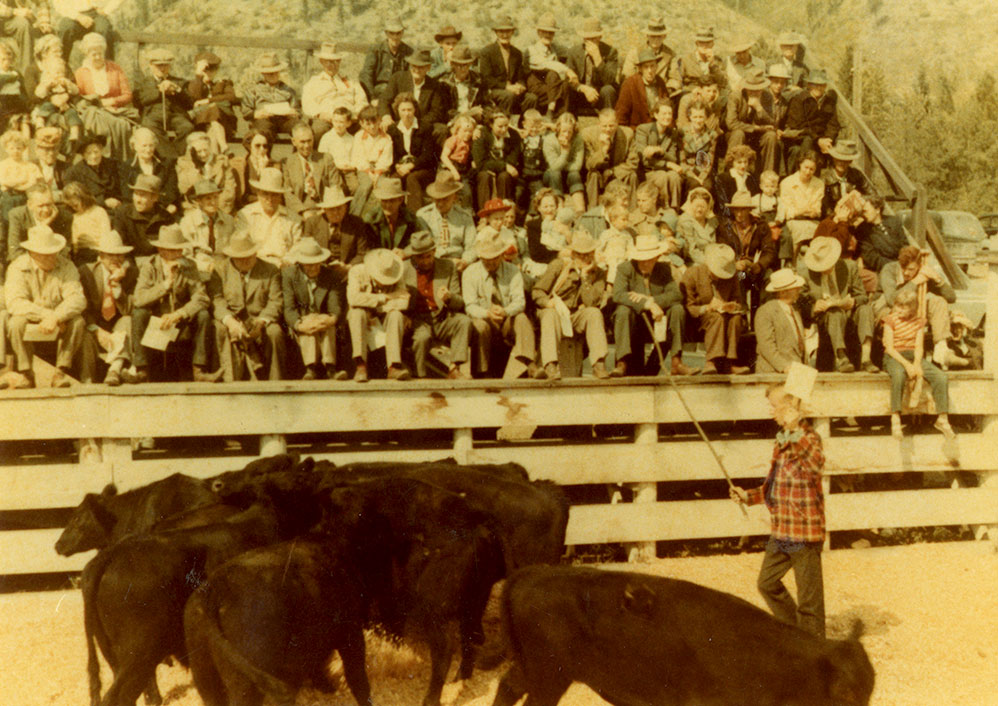
Listening to the District Agriculturist and other government supporters, the Waldo Stockbreeders’ Association realized that they could help themselves by preparing for and holding an annual stock sale in their district.
At the August 17, 1941, Special Meeting of the Association, it was agreed to spend $150 to purchase a scale and have it inspected by the Inspector of Weights and Measures. At the same time, a committee was appointed to go to Elko to select the scale site and a site for stock corrals.
Elko proved the perfect location with CPR connections throughout the province and Alberta. Forestry was asked for a Timber Permit for the cutting of corral poles in Mr. Ellis Sweet’s name.
The Waldo Stockbreeders’ Association moved forward with good speed and thought. By the Spring of 1942, plans had been drawn up for the Elko Stockyard, and an appointment was made to meet with the Canadian Pacific Railway Superintendent. A committee of two was struck for this purpose: Jack McDonald and Jack Aye. At the Annual General Meeting in Baynes Lake on April 12, 1942, the membership voted unanimously to sell their beef by local auction, and 17 people signed up to contribute voluntary labour to corral construction. When the question of entering cattle in the sale without contributing labour, the membership voted to include and not charge extra people who did not contribute labour.

At a Special Meeting in Baynes Lake on May 20, 1942, final plans were made to construct auction pens at Elko. The secretary was directed to write Fairbanks-Morse and the Gurney Scale Company for prices and terms on a 10-ton platform scale. Mr. Kelly at Newgate was also contacted, offering $30 for the quarantine pens and barn he had there. Mr. Cameron, a Forestry rep from Fernie, was thanked for assistance in getting the permit to cut poles.
Work commenced Monday morning, June 8, at 8 a.m., on the auction pens with Mr. Ellis Sweet, foreman in charge and Mr. Belanger foreman in the woods. Work on the corrals broke so some could attend the Farmers’ Institute Convention in Fernie, then re-commenced on Wednesday, June 17. A tentative October 14-16 date was set for the Cattle Sale, and the secretary was asked to contact Mat. Hassen in Armstrong regarding a suitable auctioneer.
In August, an agreement was reached with Standard Scale Service to ship the platform scale. The quarantine pens at Newgate were taken down immediately and trucked to Elko by J. McDonald. Authority to hire an auctioneer was given to Wm. McGillivray. At a Special Meeting in Baynes Lake on September 13, 1942, final arrangements were made, and the Association was committed to a Cattle Auction Sale at Elko on October 17. Mr. McGillivray thoroughly explained sale procedures and drew clear plans for the first sale.
A Sales Committee was appointed to work with Bill McGillivray: William Belanger, C.H. Christensen, Jack Aye, R. Fitzpatrick and J.A. McDonald.
William MGillivray and Jack Byers, provincial and federal agricultural specialists, worked with the Association to understand the chaotic outside cattle market and wartime price ceilings and chart a course for South Country ranchers. On October 20, 1942, a meeting was called a general meeting to discuss the results of the first cattle sale and discuss improvements for next year’s sale. J. McDonald was asked to complete the sale enclosure. Then at a meeting on December 18, 1942, it was decided to build an additional 25 corrals and a holding pen for the next sale.
Mr. Cierny was awarded the post-cutting contract, and Mr. Sweet undertook the dirt moving and levelling for $50. For the second sale, the Triangle Women’s Institute was offered a lunch stand and sale of goods. In March of 1943, the Waldo Stockbreeders’ Association purchased a 12’x16’ cabin from Mr. C. Tanner, Sr., for $15 and moved it to the cattle auction site. In July, the WSA paid $10 to Mrs. Swope and took up her option on land parcel 10A adjoining the Elko corrals. Fall sale entry prices were set at $1 for ranchers in the WSA area and $2 for any vendors outside the area. Twenty-five cents a head per day was to be charged for feed.
Sheep producers were asked to build their corrals and would be charged 1.5 % of commission on sales (cattle at 3%) or pay a $75 deposit by September 1, and the Association would build the corrals.
J. McDonald was asked to look after water and electricity in the cattle sales area. Mr. Munro and Mr. Allin were designated to look after the 1943 prize money for the 4-H Calf Club.
On November 24, 1943, $1000 was received from the Minister of Agriculture to support the continuance of the Cattle Sale – $500 to be spent on corrals and $500 for the dining hall construction sale site.
The Association decided to invite the Triangle Women’s Institute to the next meeting on December 10 to consult on the dining hall building.
At the December 10 meeting, it was agreed to call tenders for building either a 20’x40’ or 20’x50’ dining hall. The building of additional corrals and bleachers was referred to the Executive.
For the 1944 Cattle Sale, Jack Aye was hired as Sale Manager at $200 annually and .10¢/mile on sale business. The Stock Sale was to be held September 15, or the first Saturday after the 15th each year. The secretary was also voted a commission on a successful sale due to the specific workload of the sale. Additionally, it was decided to pay Mrs. Swope $250 to purchase Lot 22A adjoining the sale site. Both the President and the Secretary were detailed to accompany Mr. Allin to the Windermere District to encourage stock breeders there to enter more cattle in the sale.

On April 21, 1944, John McDonald was awarded a $483 contract to construct a dining hall at the Elko sale site 20’x50’x8’ with five windows, two doors and a rubberoid roof. At the same time, John Cierny and Jack Aye were awarded a $400 contract to construct corral additions according to plans. William Belanger and jack Aye were appointed to meet with CPR Superintended McLean regarding the corral improvements. In addition, the secretary was asked to look into fire insurance costs for the Elko complex. In July, the Cranbrook Gyro club was approved to set a concession on the day of the sale, with $50 or 2% of the proceeds going to the WSA.
The Triangle Women’s Institute was given a three-year lease on the dining hall for $40 annual rent, launching a long and friendly relationship between the two organizations. It was also agreed that the TWI would build a kitchen onto the dining hall and be reimbursed for the value of the kitchen at the end of their three-year lease. The Waldo Stockbreeders’ Association agreed to pay the taxes, and the Triangle Women’s Institute paid insurance and upkeep. John McDonald was hired to build the kitchen onto the hall at the cost of $151
In 1945 the Association decided to charge a 2% commission on all sheep included in the sale. Further, each sheep owner was made responsible for feed, water and the pens for his sheep. However, just before the 1945 Sale commenced, it was agreed to exclude sheep as the volume was too small.
After the sale, a committee of three was appointed to arrange for general improvements to the Elko stockyard: J.A. McDonald, B. Belanger and C.H. Christensen. At the same time, another meeting was arranged with the CPR to discuss further stockyard improvements.
 Waldo Stockbreeders' Association