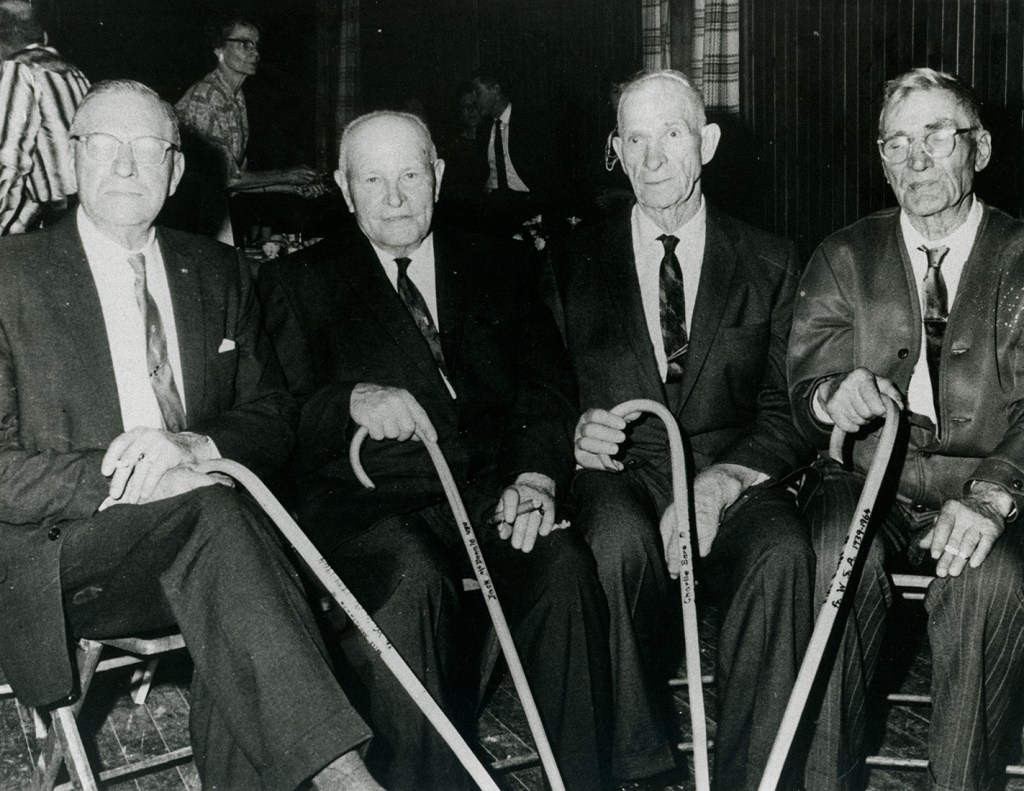
The first meeting of the Waldo Stockbreeders’ Association took place in Waldo on May 16, 1939. Ellis Sweet was elected chairman, and the first order of business among the ranchers assembled was stray horses, that they be rounded up and sold, and the money realized used by the Association. C.H. Christensen was elected secretary-treasurer but was replaced by Marguerite Aye at the second meeting in June, also held at Waldo. At this meeting, the formal name ‘Waldo Stockbreeders’ Association’ was accepted, and the physical boundaries of the district to be served were established and later accepted by Forestry:
Westside of the McDonald Range from the International Boundary to Bull River; from Bull River down the Kootenay River to Plumbob Creek, then across the Kootenay to Gold Creek; then follow Gold Creek to Gold Mountain; then straight south to the International Boundary.
There were twenty-two paid-up members, and they elected the following Directors: Walter Sweet, Jack Aye, John Mojak, C.H. Christensen and A. Lindberg.
These men had gathered to try and improve their economic circumstances and survive as ranchers. However, world War II was beginning, and price controls were making themselves felt throughout the cattle industry. Markets were far removed, and the South Country found itself at the whim of cattle buyers moving through from the south and east, offering low prices.
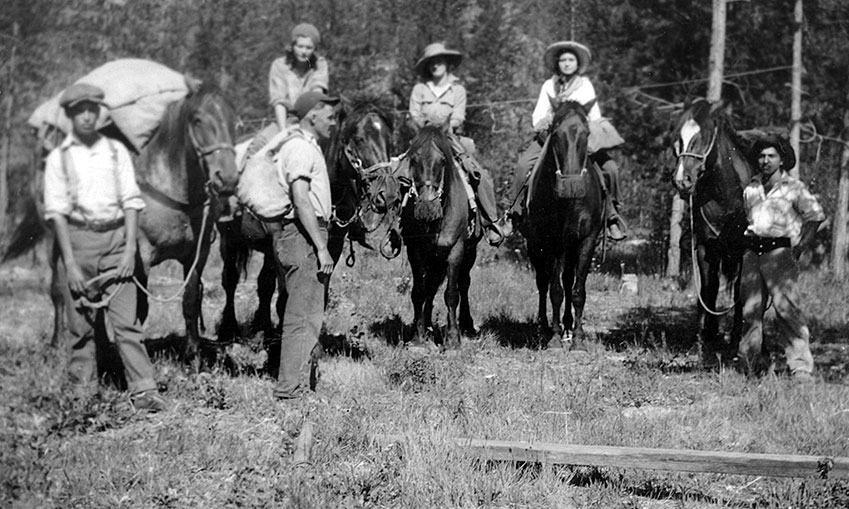
On October 22, 1939, in their third meeting at Baynes Lake, the Association got down to business, voting to close the range to horses from April 1-30, inclusive, so that the range might rejuvenate and produce better cattle browse. Some of the other work at the meeting included asking Forestry to partner in a fencing project at the Fussee Lake bog hole. At this meeting, the proposal to have only registered bulls be allowed to run in the entire Waldo Stockbreeders’ area first came up.
A special note was also made of sheep being grazed by Mr. Obrey in the Sheep Mountain area. Three representatives of the Forestry Department attended this meeting, signifying that the ranchers knew that they had to work with the government to make their conditions better and their industry more viable. It was a partnership that continued to bear fruit.
At the first Executive Meeting at Waldo on November 19, 1939, George Reay was voted access to the range adjoining his property and the property adjacent to the Mud Creek and the Jaffray-Sand Creek road. This was the first of many similar decisions throughout the history of the Association, matching Crown land with rancher needs.
To this end, the Executive decided to secure a complete map of the district to assist with all further allocations.
At the January 10, 1940, meeting at Baynes Lake, limits were placed on Association membership – two people per registered brand – and then the restriction was promptly cancelled. Mr. Sweet was returned to office as president and Mrs. Aye as secretary-treasurer (she would hold that position for 24 years). Jack Aye was elected vice-president, and the Executive Committee was: Jack McDonald, Charles Lindberg, C.H. Christensen, Bill Sweet and John Mojak. There were now forty-two paid-up members.
The previous motion to close the range to horses was withdrawn as the Association had assumed Forestry would undertake the expense and follow through by cleaning up the range, but that did not appear to be the case. The Waldo Stockbreeders’ passed a resolution that the notice to withdraw be accompanied by a request that Forestry enforces the Nuisance Act on stallions in the entire area controlled by the Waldo Stockbreeders’ Association under section 19 of the Animals Act. This sophistication of using government regulation to further their interests grew and became a hallmark of the Association. This is World War II, and meat rationing and supply limits are in place, as is gas rationing. It was a hard time for everyone, and the intelligent South Country ranchers knew that working together was the way to survival. The Association moved forward at its April 21, 1940 meeting in Waldo, hiring Gus Costanzo and Paul Mojak for two days, And Mr. Costanzo and A. Sandberg for an additional day, all at $3.00 per day. Their task was to ride the range, locate stallions and take descriptions and brands if any. Mr. Brewer of Nelson represented Forestry at this meeting, and the Association was explicit in wanting to develop a continuing positive relationship with the government.
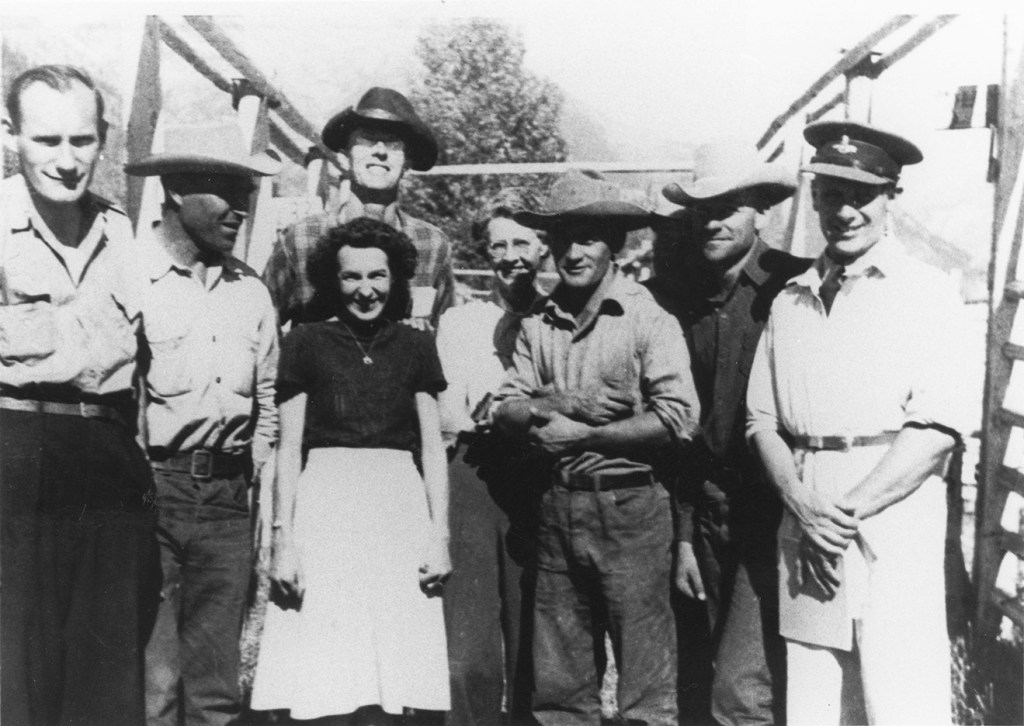
Minutes of the Association indicate that professional advice was sought and listened to in the areas of herd improvement and that alliances were soon formed with other agricultural associations to further the WSA’s intention to remove unclaimed horses from the grazing district. At the same time, the vaccination of horses for encephalitis was endorsed, and Mr. Irvine, Indian Agent, was requested to take up the same issue with Ktunaxa horsemen. Americans near the Newgate boundary were notified to remove their horses from the Canadian side before they were sold at auction.
The Association began securing taxation information on grazing and hay cutting permits, sources and prices for bulk purchasing, advice on the use of mineral salts and partnerships with Forestry on fencing projects.
Showing a growing willingness to work with the government to achieve their objectives, at their first Annual General Meeting on April 6, 1941, the Association voted a three-year limit on all bulls used on the open range. It then opened a dialogue with the Department of Agriculture to acquire bulls through this arm of government. As well, Forestry was again asked for assistance in putting riders on the range. Residents of Fernie were informed that the district range was overstocked and requested residents to remove their stock. Fernie people and regional guide-outfitters regularly turned their horses loose on this range.
On August 17, 1941, a Special Meeting was called at Baynes Lake, and the Waldo Stockbreeders’ further experienced the benefits of organizing.
The District Agriculturist from Salmon Arm, a District Supervisor for the Dominion Department of Agriculture at Calgary, and Mr. Brewer from the Nelson Forest Services and B.C. were in attendance. Provincial Police Constable Neff from Fernie. All of these gentlemen had been providing continued assistance to the developing Association. It was agreed to secure political help to have section 19 of the Animals Act made a Proclamation for East Kootenay.
At the 1943 AGM, J. McDonald requested the circulation of a petition that would close the WSA range to horses for January and February 1944. The Association put the following people in charge of circulating the petition widely: Ellis Sweet, Waldo; Jack McDonald, Roosville; C. Bare, Grasmere; W. Earl, Newgate; L. Rosicky, Wardner; J. Gormick, Jaffray; J. Cierny, Galloway and; Jack Aye, Sand Creek.
In July 1943, at a Baynes Lake meeting, Mr. Allin, the new District Agriculturist, was introduced to the Association. The agreement was reached that the entire grazing area covered by the WSA be defined as a Bull Control Area and that a public meeting be called In September regarding the subject. At the same time, the Munro family from Newgate moved that a committee be established to draft a Resolution regarding “Agricultural Training” for boys and girls. The committee consisted of A. Munro, W. Earl and Mr. Morrow. The Association wrote to the police at Fernie on November 24, 1943, requesting enforcement of the removal of J. Anderson’s Shorthorn bull from the range and the allotted time was finished. Then in December, the Association, along with the Triangle Women’s Institute, engaged in lobbying for more efficient mail delivery from Canada Post. As well, talks were begun with Forestry Branch regarding fencing of the International Boundary. Branded Canadian animals were being sold in Great Falls, Montana.

In April 1944, work was begun on creating Bull Control Areas. Then in July, looking forward, J. McDonald was designated as representative of a Post-War Rehabilitation and Reconstruction process when that occurred.
At the September 6, 1944 meeting, jack Aye was elected president of the Waldo Stockbreeders’ Association, with J.D. McDonald of Roosville as vice-president. Marguerite Aye resigned as secretary-treasurer and was replaced by J.D. McDonald. The Directors elected were C. Bare, Allister Munro, C.H. Christensen, B. Belanger and John Cierny. Given the volume of work generated, the Association voted an annual salary of $120 to the secretary-treasurer and $10 to the Calf Club toward their sale prize money.
In 1945 a resolution was sent to the Minister of Agriculture requesting the Minister “to provide or to define” the ‘Cranbrook Grazing District.’ The resolution stipulated that it be a district in which every stallion, whether branded or unbranded, at the age of one should be deemed a public nuisance and shot by an authorized person as outlined in section 19 of the ‘Animal Act.’
Another resolution went to the Minister of Lands, stating that the WSA applied to the Minister of Lands to have a rider employed for twelve months to shoot stallions in the ‘Cranbrook Grazing District’ as outlined in section 19 of the ‘Animals Act.’
At the same time, the Association closed the Waldo Stockbreeding District to cattle, horses and sheep belonging to outsiders. They agreed no new grazing permits for horses, cattle or sheep would be issued in the district governed by the Association unless approved by them. Forestry was requested to take steps to improve the range by re-seeding, watering conditions, early and late pasturing, and cleaning up after useless horses.
The pressure was applied to settle Bull problems in the Waldo area. The Association received a lot of attention and help from the government, and on May 19, 1945, the Reay brothers tabled and passed motions to remove all Bulls from the range and then to specialize.
On October 14, 1945, the Association arranged a yearly lease of some of their land to the Knight Lumber Company, with a fifteen-year renewal option. The financial base was being widened. Following, on October 27, a large meeting was held at Elko to review the Dominion Bull Loaning Policy. Mr. N. Curtis and District Fieldman advised the Association to set up separate committees for each Bull Control Area. The Association members divided into their districts – the Polled Angus area and the Hereford area.
At the same meeting, the Association again voted to clear the range of useless horses. The District Agriculturist went over the government’s ruling regarding this. Then, at a Special Meeting in Baynes Lake, November 24, 1945, the Association appointed three men to look after the round-up of all horses on Crown range in the area of the Waldo Stockbreeders’ Association – J. McDonald, J. Aye and A. McIntyre. The Newgate Farmers’ Institute would round up all horses on Crown range in the area bordered by Gold Creek on the north, the Kootenay River on the east, the International border on the south and the range of mountains on the west.
As a result of the round-up Ed Dilts had acted through the Baynes Lake Farmers’ Institute to secure access to the Elko stockyard corrals for halter-breaking horses that he was buying. There were objections by the Waldo Stockbreeders’ Association to Mr. Dilts acting through the Baynes Lake Farmers’ Institute to secure their corrals for personal use. Damage was done to the facility, and C. Bare and C. Nohels were appointed to appraise the damage and, if unable to collect the costs from Mr. Dilts, turn the matter over to the police court. The corrals were subsequently locked and declared a No Trespassing area.
Shortly after that, the Baynes Lake Farmers’ Institute issued a petition to Forestry requesting that the Black Angus Bull Management Area boundaries be dissolved and that a new Association be formed in that district. However, forestry said it would not recognize another Association as long as the WSA had a majority of the ranchers and were of good standing in the district. The Waldo Stockbreeders’ Association followed this by passing a motion that stock owners living out of and not owning land within the boundaries of the WSA not be allowed grazing permits in the area.
In 1946 additional office space was built at Elko. There was a lengthy discussion regarding the horse round-up with Mr. Boys, now Indian Agent at Cranbrook. Six horses were shot at Elko after the round-up belonging to Ktunaxa people, and $100 was paid to Mr. Boys, who suggested that all future arrangements with the Ktunaxa be made through him. The WSA decided to request that B.C. Provincial Police be charged with any future shooting of horses during range closures. Another two years of range closures were agreed upon, December 15 to March 15 in 1946 and 1947.
 Waldo Stockbreeders' Association